The Climate Is Changing. So Is the Landscape of Disease
Writer: Dr Devender Singh Meena & Utkarsha Rathi
The recent rise in H1N1 cases is a reminder that public health can no longer be separated from climate and ecological change. The next public-health warning may not always arrive in the form of a new virus. Sometimes, it comes from a familiar one behaving differently.
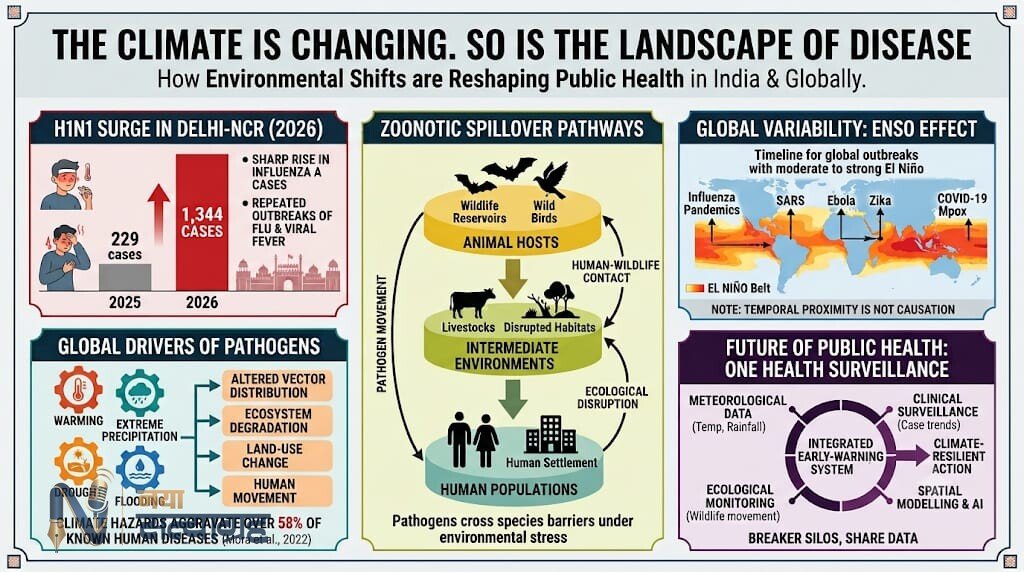
In Delhi this year, reported H1N1 cases have risen sharply. According to recent reports, Delhi has recorded 1,344 H1N1 cases in 2026, compared with 229 during the corresponding period last year. Hospitals across Delhi-NCR have also reported an increase in influenza and viral-fever cases.
It would be tempting to look at these numbers and blame the weather. But that would be too simple. H1N1 is an influenza A virus, and its transmission is shaped by a combination of viral evolution, immunity, human movement, contact patterns, environmental conditions and seasonality. What climate change does is add another layer of uncertainty to this already complicated system.
That distinction matters.
A growing body of research is showing that climate is not merely the background against which infectious diseases occur. It can influence the ecological and environmental conditions that determine where, when and how strongly diseases circulate.
A landmark global analysis published in Nature Climate Change found that more than 58% of known human pathogenic diseases can be aggravated by climate-related hazards, including warming, flooding, drought and extreme precipitation.
The pathways are often indirect. Changes in temperature, rainfall and humidity can alter the distribution of disease vectors. Ecosystem degradation and land-use change can modify wildlife habitats and increase opportunities for pathogens to cross species barriers.
Influenza offers an important example of why this deserves attention.
Unlike diseases transmitted by mosquitoes or contaminated water, influenza is primarily transmitted between people. Yet its transmission is still influenced by environmental conditions and seasonality. Research published in 2025 found that climate warming can alter the seasonal and interannual dynamics of influenza, potentially changing the timing and intensity of outbreaks.
A 2026 study has gone further, highlighting the instability of influenza seasonality when multiple viral strains circulate simultaneously.
This does not mean that climate change is responsible for every flu outbreak. It means that the old assumption of a predictable disease calendar may become increasingly unreliable.
India is particularly important in this discussion. The World Health Organization notes that influenza circulates in India and that both seasonal and avian influenza have been widely reported. Seasonal influenza can produce serious illness, particularly among young children, pregnant women, older adults and people with underlying health conditions.
And influenza is not the only concern.
Climate variability can influence infectious diseases through multiple pathways. The El Niño–Southern Oscillation (ENSO)—the natural climate system linking changes in Pacific Ocean temperatures with atmospheric circulation—is one of the world’s major sources of year-to-year climate variability. Its effects can include changes in rainfall and temperature, droughts and floods. WHO recognises that ENSO-related climate changes can alter transmission patterns of vector-, rodent- and water-borne diseases.
The scientific literature also raises questions about influenza. The research compiled for this article found temporal overlaps between several major disease emergencies—including influenza pandemics, SARS, Ebola, Zika, COVID-19 and Mpox—and periods of moderate to strong El Niño activity. But the important caveat is that temporal proximity is not causation.
That caveat should remain at the heart of the climate-and-disease conversation.
The real concern is not that a warming planet will automatically produce the next pandemic. Rather, environmental change can reshape the conditions in which pathogens circulate, hosts move, vectors survive and humans interact with wildlife.
The story of emerging infectious diseases illustrates this clearly. Influenza viruses have reservoirs in animals; WHO continues to monitor zoonotic influenza viruses at the human-animal interface because new influenza viruses can occasionally cross into humans. The same ecological logic has been seen with other diseases. Changes in wildlife habitats, food availability and human-wildlife interactions can create new opportunities for spillover—the movement of a pathogen from an animal host into humans. The scientific literature has examined these pathways for diseases including avian influenza, SARS and Ebola.
This is why climate change should increasingly be treated as a health-system issue, not only an environmental one.
India’s disease surveillance systems need to speak more closely with meteorological and ecological monitoring systems. Temperature, rainfall, humidity, land-use change, wildlife movement and disease surveillance should not exist in separate silos.
We already have many of the tools required: GIS, spatial modelling, climate forecasting, artificial intelligence and early-warning systems can help identify changing environmental conditions before they translate into a larger public-health problem.
The recent H1N1 rise should therefore not be read as evidence that climate change has caused an outbreak. It should be read as a reminder.
The boundaries between climate, ecosystems and human health are becoming increasingly difficult to draw.
The question we should be asking is no longer simply, “What disease is spreading?”
It is also: “What is changing in the environment that may be helping it spread—and can we see that change early enough to act?”
That is where the future of climate-resilient public health may begin.